My group-chat bot, tldr, started life
summarizing voice messages. This week it learned a second trick: /roast.
You reply to any post with it (a forwarded channel post, a photo, a voice
message) and the bot answers with one short, dry joke.
It came from a real moment. Someone in our chat forwarded a post from the channel of a founder who had sold his company to Yandex. The post was a photo of a British TV studio: a big screen titled “IF YOU HAVE TO… HEAT THE HUMAN NOT THE HOME”, with heated gloves for £12, heated insoles for £26 and a hot water bottle for £3.50. The caption said, roughly, “Winter in Britain. Heating your home is expensive, so they advertise heaters for people only ;)”.
The chat’s reaction was the usual mix of laughing and sighing. I wanted the bot to join in. It took three rounds to get there:
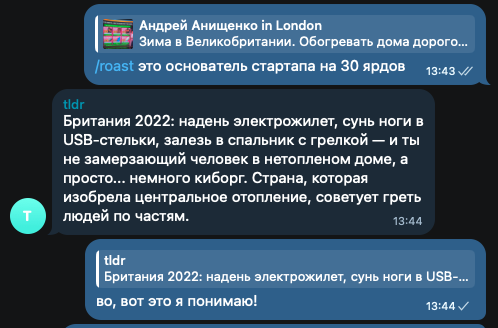
That last line in the chat is the bar I was aiming for. Here’s how the bot got there, and the three things that went wrong first.
How /roast works
It reuses everything from the summary bot: the webhook checks the chat and the quota, puts a job on SQS, and a worker Lambda does the slow part. The new parts are about what the bot can see:
- Text and captions. A forwarded post arrives in
reply_to_messagelike any other message, with its text or caption. - The picture. Telegram sends every photo in several sizes, smallest first. The webhook picks the largest one under 3.75 MB, which is Bedrock’s limit for an inline image, and the worker passes it to the model as an image block.
- Where it came from.
forward_originsays whether the post came from a user, a hidden user, a group or a channel, so the bot knows the author is an outsider and not someone in the chat. - Voice and video. These are transcribed first, then roasted, using the
same Amazon Transcribe path as
/tldr.
One thing the bot can’t see is the conversation around the post. It runs in
Telegram’s privacy mode, so in a group it only receives commands, plus the one
message the command replies to. If you wrote “look at this, a founder with a
30-billion company is posting about hot water bottles” just above the forward,
the bot never sees it. So anything after /roast goes to the model as context:
/roast this is the founder of a 30-billion startupThat context line is useful. It also caused two of the three problems below.
Round one: the bot roasted me
The first version ran on Amazon Nova Lite, the same small model that writes the summaries. I tried it on the heating post with the founder context, and got this:
Виктор Карпов, твой стартап стоит 30 миллиардов, а вот зимой тебе придется таскать микроволновый мешок за 10 фунтов.
“Viktor Karpov, your startup is worth 30 billion, but in winter you’ll have to carry around a microwave bag for £10.” I’m Viktor. I forwarded the post. The startup isn’t mine.
The prompt gave the model three people: who forwarded the post, who asked for the roast (both me), and the original author. Then came a context line about “the founder”. The model had a name it could address and a description it could attach to it, so it joined them up.
The fix had two parts. The prompt now spells out who is who: the author of a forwarded post is “an outsider, not anyone in the chat”, the people in the chat are on the bot’s side, and nobody gets addressed as “ты” (“you”). And the bigger change: the model no longer gets any chat member names at all. It doesn’t need them to write a joke, and a name in the prompt is a name the model will try to use.
I changed both at once, so I can’t say which one did the work. But I’d make the second change first next time: don’t give the model a name it doesn’t need.
Round two: a better model, the wrong target
Nova Lite had a second problem: its Russian humor. That first reply ended with “we’ll all live in burnt shells, and you’ll be in an electric gilet”. It’s grammatical, and it doesn’t mean anything. I added a few example roasts to the prompt, but I didn’t expect a small model to become witty in a language that isn’t its strongest.
So /roast now runs on Claude Sonnet 4.6 on Bedrock, behind a separate
roast_model_id setting. Summaries stay on Nova Lite, because they’re about
getting facts right and Nova is fine at that. A roast is one short call with an
image, so a bigger model costs a fraction of a cent more per joke.
The Russian got much better right away. The target didn’t:
Человек продал бизнес на 30 млрд Яндексу, переехал в Лондон — и теперь с восхищением фотографирует грелку за 3.50 фунта. Это называется «адаптировался к местной культуре».
“A man sold a 30-billion business to Yandex, moved to London, and now admires photos of a £3.50 hot water bottle. That’s called ‘adapting to the local culture’.” It’s a good joke, at the author’s expense. All three test runs were the same joke: rich guy, cheap hot water bottle.
The trouble is that wasn’t what the chat wanted. Nobody was laughing at the
author. He was laughing at the situation himself, with a ;) at the end, and
we were laughing along. A friend in the chat doesn’t answer that by mocking
the person who shared it. They pile on: “it’s even worse than that”.
Round three: complain together
That changed the prompt from “roast the post” to something closer to “join in”. The core of it now reads:
Your job is to join in: pick up the emotion of the post (frustration,
disbelief, exhaustion, irony) and complain along with everyone in the
funniest way possible. You roast the situation, never the person.
Then a few rules that make it concrete:
- You’re on the author’s side. Whatever they’re sighing about (prices, weather, bureaucracy, tech), you sigh too, louder and funnier.
- The target is the situation. Don’t mock the author’s money, naivety or choices, and don’t make the joke “look who’s talking”.
- Amplify, don’t explain. Take the absurd detail and push it one step further.
I also replaced the examples, because the model copies examples more closely than any rule. The new ones are all about shared pain: a 590-ruble latte, a phone update that deleted someone’s notes, the earliest doctor’s appointment being in March.
That still wasn’t enough. Two of the three runs led with the founder’s money again. The culprit was my own context line: “founder of a 30-billion startup” sat in the prompt and pulled the joke toward the person. The fix was to say what the context is for:
It is background that tells you how absurd things have got ("even he is
writing about this"); it is not the subject. The joke is about the
situation: don't build it on the author's money, career or biography.
After that, all three runs went after the situation:
“Heat the human, not the home” — это уже не лайфхак, это диагноз. Шестая экономика мира, а решение — грелка за 3.50 и носки с проводом.
“‘Heat the human, not the home’ isn’t a life hack anymore, it’s a diagnosis. The world’s sixth-largest economy, and the solution is a £3.50 hot water bottle and socks with a cable.” Same facts, same picture, but now the bot is on our side.
It still makes things up
Look at the screenshot again: “Britain 2022”. The post has no year, and the chat happened in 2026. In testing, the model also invented a “2024” and an “80 square meter” flat. The prompt now says not to state years, dates or figures that aren’t in the post, the image or the context. The screenshot shows the rule doesn’t always win. A joke wants a specific detail, and when there isn’t one, the model makes one up.
For a group chat I can live with that. For anything where the facts matter, I wouldn’t rely on a prompt rule alone.
Getting Claude on Bedrock took three tries
The code change for Claude was small. Getting the account to allow it took longer. Each step failed with a different error:
- Newest models: “not available for this account”. Claude Sonnet 5.5 and
Haiku 5.5 are listed in eu-west-1, but calling them returned
AccessDeniedException. Older models like Sonnet 4.6 answered, so I went with Sonnet 4.6. - “Model use case details have not been submitted”. A few minutes later, Sonnet 4.6 stopped answering too. Anthropic models on Bedrock need a one-time use-case form per account: company, industry, intended users, and a short description. My first calls seem to have slipped through before that check kicked in. After I submitted the form, access came back in about four minutes.
INVALID_PAYMENT_INSTRUMENT. Claude on Bedrock is billed through an AWS Marketplace subscription, created on your first call. Mine couldn’t be created because the account had no valid payment method. After I updated the billing details, it worked a couple of minutes later.
Two smaller things worth knowing. Claude models in eu-west-1 only run through
the eu. cross-region inference profiles, so the IAM policy needs both the
profile ARN and the foundation model ARN in every region it routes to. And if
your AWS CLI is a bit old, aws bedrock list-inference-profiles doesn’t exist
yet. A tiny converse call with maxTokens: 5 was the quickest way to check
access.
What I’d take from this
- Decide whose side the bot is on. “Be funny” isn’t a spec. “Be the friend who complains along with you” is, and it changed every joke.
- Say what each input is for. Context that’s meant as background will be used as the punchline unless you say otherwise.
- Leave out what the model doesn’t need. A name in the prompt is an invitation to use it.
- Use the cheap model where it’s good enough. Summaries stay on Nova Lite, and only the part that needs wit pays for a bigger model.
The code, the prompt and the Terraform are on
GitHub. The prompt is in
internal/summarize/summarize.go, if you want to make your own bot complain
about your weather.